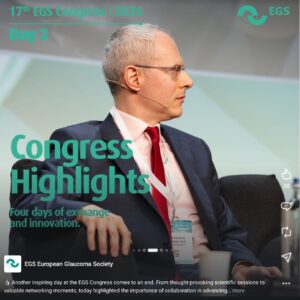
17th European Glaucoma Society (EGS) Congress in Brussels

The 17th European Glaucoma Society (EGS) Congress officially comes to a close. Over the past four days, glaucoma specialists, researchers, surgeons, engineers, and innovators gathered in Brussels to exchange knowledge, advance collaboration, and shape the future of glaucoma care together. From Surgery Day and Imaging Day to hands-on courses, plenary discussions, and scientific poster sessions, #EGS2026 highlighted the strength and global spirit of the glaucoma community.

Mr Lascaratos had the honour and pleasure to co-chair the plenary session ‘With a little help from our friends in neuroscience’ on Sunday 31 May with excellent talks delivered by Dr Aki Kawasaki, Prof Miriam Kolko, Prof Jonathan Crowston, Prof Fotis Topouzis and Prof Jeffrey Goldberg. It was inspiring to hear about the future of neuroprotection in glaucoma, the expanding role of genetics and the challenges of eye transplants.
A deeper understanding of glaucoma

Glaucoma is the leading cause of irreversible blindness worldwide, expected to affect 80 million by 2030.

The biggest known risk factors are ageing and higher pressure in the eye, with all currently licenced treatments working by lowering this pressure. But not everyone responds to treatment, and not everyone’s glaucoma progresses at the same rate. Why is this?

Findings from Moorfields Eye Hospital and UCL are bringing us closer to the answer, identifying new indicators that can show us who is likely to still have vision loss despite treatment. This study was conducted building on previous work funded by Fight for Sight.


The findings are likely to have an impact on how we monitor – and potentially treat – patients with glaucoma in the future. But first let’s break down the research.

Please read more here

Nature Medicine publication from our group identifies novel biomarkers for glaucoma

We show for the first time that lower systemic mitochondrial function (as measured in peripheral blood) is strongly linked to faster glaucoma progression. This is an exciting development in the field of glaucoma and our findings have practical implications for clinical decision making. Low mitochondrial function may identify patients at risk of faster glaucoma worsening and inform personalised treatment strategies, offering the potential for future mitochondria-targeted therapies.

Please read more here

Mr Lascaratos co-leading landmark neuroprotection trial in glaucoma funded by the NIHR

A prestigious £2.0 million grant has been awarded to a team of researchers, led by Professor Ted Garway-Heath at the UCL Institute of Ophthalmology/Moorfields Eye Hospital and Mr Gerassimos Lascaratos at King’s College Hospital, to conduct a novel neuroprotection trial to treat glaucoma. The grant, awarded by the National Institute for Health Research (NIHR) and the Medical Research Council’s EME programme, could potentially benefit 300,000 people in the UK living with glaucoma, the leading cause of irreversible blindness worldwide.

The trial will look at whether nicotinamide tablets, a form of vitamin B3, can improve mitochondrial function (energy production) and delay sight loss in people with primary open angle glaucoma (POAG), the most common type of glaucoma. Mr Lascaratos and Professor Garway-Heath will be using mitochondrial function in peripheral blood (blood that flows through the veins and arteries) as a biological marker of glaucoma and to monitor response to treatment, in the hope to offer more personalised treatment to patients. This is the first time such a study has been carried out for this condition in the world. The team will be recruiting patients from seven UK sites, including King’s College Hospital, and the trial will finish in November 2026.

Please read more here

The new iStent inject W

Mr Lascaratos is now using the latest version of the iStent inject device to reduce intraocular pressure safely and effectively in patients with glaucoma. The new design aims to improve stent visualisation and placement and enhance procedural predictability. The new iStent inject W is designed to lower the intraocular pressure by improving the outflow through the drainage system of the eye and can reduce the need for glaucoma drops. It may be implanted at the time of cataract surgery or as a stand-alone procedure. Please watch how it works.
Play Video

Does someone in your family have glaucoma?

Have you been told that your eye pressure is high or that you may suffer from glaucoma? Have you been tested for glaucoma? Glaucoma is the most common cause of irreversible blindness worldwide. Yet, as it doesn’t usually give any symptoms, about half of all patients with glaucoma in the UK are not even aware they have it. In this article, Mr Gerassimos Lascaratos, answers your frequently asked questions on Glaucoma.

https://www.spirehealthcare.com/spire-london-east-hospital/patient-information/news-and-events/the-silent-thief-of-sight


Mr Lascaratos is delighted to be using the new InnFocusMicroshunt at King’s College Hospital

Mr Lascaratos is delighted to be using the new InnFocusMicroshunt at King’s College Hospital. This new minimally invasive glaucoma surgery device appears to achieve a significant eye pressure lowering effect,while maintaining an improved safety profile compared to traditional approaches. The Microshunt is similar to a trabeculectomy in that it creates a subconjunctival bleb, but the procedure is considerably less invasive and requires much less postoperative interventions and clinic visits. It has a flow restrictor 70um lumen and is made from SIBS,a highly biocompatible,biostable material that has been shown to result in reduced inflammation and minimal scar tissue formation.

Mr Lascaratos speaks at ISER 2018 in Belfast

Happy to be invited to speak about the role of mitochondrial biogenesis in glaucoma at the International Society for Eye Research (ISER) conference in Belfast and honoured to be part of such an esteemed faculty. Congratulations to Prof Colm O’Brien and Mr Patrick Yu-Wai-Man for organising an excellent session.